Memory Care

Two senior women joyfully dancing together in a warmly lit room, with "Memory Care" text overlaid
A black heart-shaped icon with a checkmark

100% Focused on Caring

Briefcase icon with clock overlay, symbolizing scheduling or time management

Professionally Trained Employees

A black tree-like icon

Safe and Secure Environment

A black flower-like icon with five circular petals

Thoughtful and Social Activities

Memory Care

Help your loved one living with memory loss live a rich, full life. The Heritage of Meyerland provides a warm and enriching environment for people with Alzheimer’s or another memory loss illness.

Signs It May Be Time for Memory Care

Every family’s situation is different, but changes in memory, safety, daily routines, medication management, or increasing caregiver needs may signal that it is time to explore memory care. Our team can help families understand their options and determine whether a dedicated memory care setting may be the right next step.

*The Heritage of Meyerland does not accept Medicaid as a form of payment. We understand that financing long-term care is a significant consideration for families, and we encourage you to discuss all available options with our team. They are here to provide guidance and support as you explore the best possible solutions for your loved one’s needs.

Starting at

$5,700*

/mo

Request More Info

Safety & Security

Our community is designed to help residents move through their day with greater comfort and confidence. Secure spaces, familiar routines, thoughtful community design, and attentive team members help create an environment where residents can remain active while families gain greater peace of mind.

Well-lit bedroom with a bed, dresser, and display in a cozy setting
A gray rectangular background with a subtle pattern of evenly spaced light dotsA gray rectangular background with a subtle pattern of evenly spaced light dots
Smiling senior couple sitting on a bench, with the man holding a small brown puppy

Activities & Daily Life

Meaningful activity is an important part of each day. Programs are designed around resident interests, abilities, familiar routines, and opportunities for connection, helping residents stay engaged socially, emotionally, and physically.

Planning a Move

Moving a loved one into memory care can feel overwhelming. Our team helps families understand what to expect, what to bring, how the transition works, and how we can make the move as comfortable and familiar as possible.

Well-lit bedroom with a bed, dresser, and display in a cozy setting
A caregiver assisting a senior person

A Loving Home to Write Your Next Chapter

The caring and professional team at Meyerland would be honored to assist you through this complicated chapter in your loved one’s life.

Care at The Heritage of Meyerland begins with a personalized plan tailored to your loved one’s unique life experience, needs, preferences, and abilities.

A Caring Team

By working closely with each resident and their family, we can help your loved one build new connections, continue to grow as a person, and even find new joy and fulfillment that may not have seemed possible.

We provide support to you and your family, helping you adjust to the changes occurring during this transitional period in your loved one’s life.

Smiling woman in black tracksuit holding hands indoors
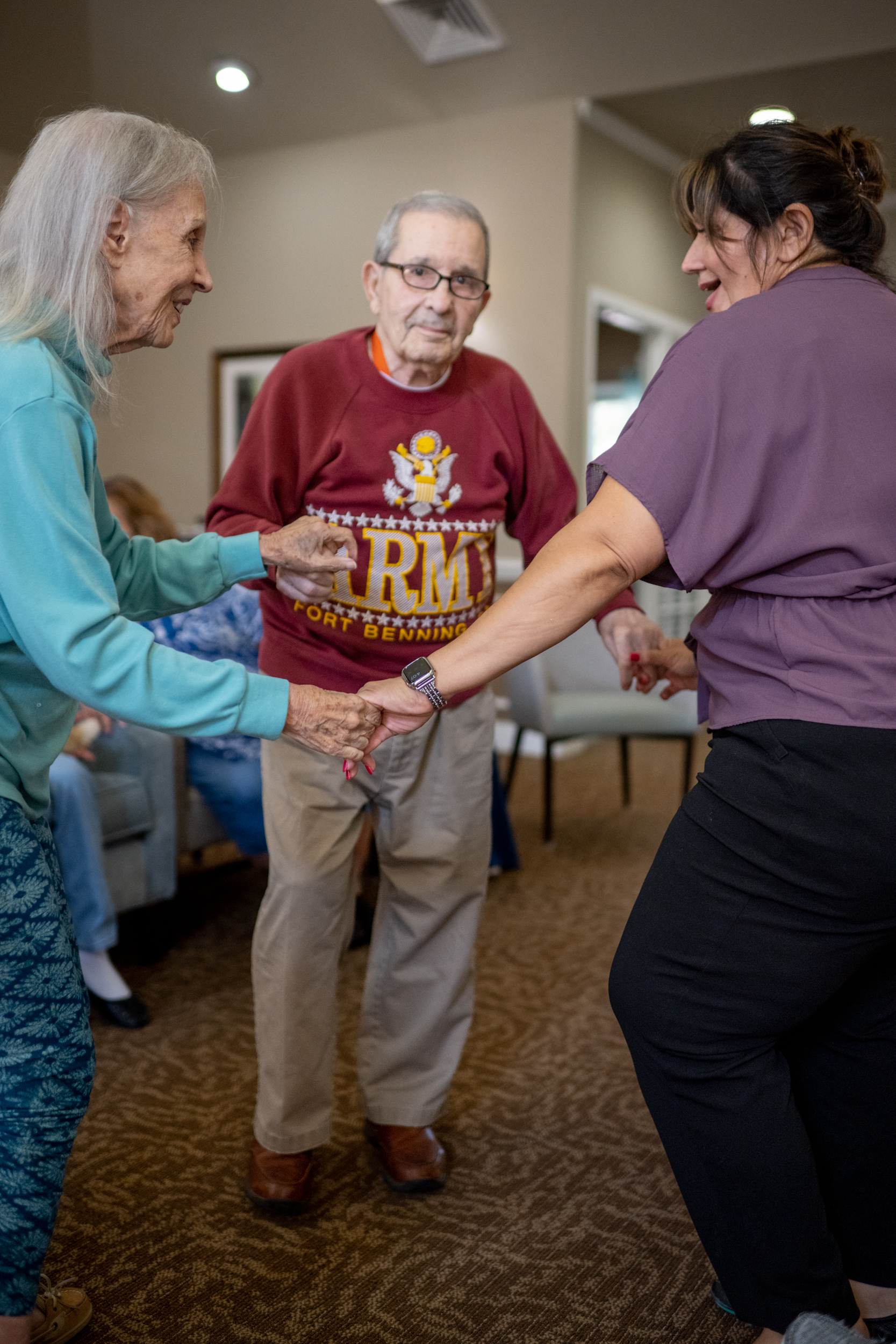
A senior woman joyfully dances while holding hands with others in a senior living community.

Support

Working with you and your family, our compassionate caregivers will learn your loved one’s life story, helping us speak to their sense of self and enabling us to treat them with the highest level of honor and dignity. Within this plan, we will also record every area in which your loved one needs care and assistance, including with activities of daily living, and their care plan will be revisited regularly so we can adjust their care requirements as needed.

An Enriching Lifestyle

With the right level of care and support, your loved one can feel confident and secure. Our purposely built and specialized Memory Care environment is designed to be easily navigable, calming, and engaging, helping your loved one safely explore their world without the danger of wandering or injury. Our compassionate caregivers are specially trained to provide nurturing care and support when it’s needed, while allowing your loved one the freedom to live life on their terms.

Every day, we provide a variety of structured activities for residents to take part in. From art classes to cooking classes, brain games, and scheduled outings, there’s something for every resident to enjoy.

To learn more about our The Heritage of Meyerland community, contact our caring team today. We look forward to speaking with you!

Contact Us
Two senior women smiling while playing pool noodles

Questions?

We are here to help! Contact our friendly team today, and we will be happy to answer all of your questions.

Contact Us
What Memory Care Includes?
Black addition icon
Memory care at The Heritage of Meyerland combines personalized support with a secure, engaging environment designed around each resident’s needs. Residents receive assistance with daily routines, opportunities for meaningful social engagement, structured activities, dining support, and care from a team experienced in supporting people living with memory loss.
What is the difference between Alzheimer's disease and dementia?
Black addition icon
Alzheimer's disease is a type of dementia. Dementia presents with a loss of thinking, remembering, and reasoning skills. It generally creates problems with a person's daily life and activities. Alzheimer's disease is the most common cause of dementia among older people. Other types of dementia include frontotemporal disorders and Lewy body dementia.
What are the early signs of Alzheimer's disease?
A black cross
Memory problems are usually one of the first signs of Alzheimer's disease. This is not the case for everyone. Each individual may have different initial symptoms. A decline in other aspects of thinking, such as finding the right words, vision/spatial issues, and impaired reasoning or judgment, may also signal the very early stages of Alzheimer's disease. Mild cognitive impairment, or MCI, is a condition that may be an early sign of Alzheimer's disease—but not everyone with MCI will develop Alzheimer's. In addition to memory problems, movement difficulties and problems with the sense of smell have been linked to MCI.
What are the stages of Alzheimer's disease?
A small black plus sign
Alzheimer's disease progresses in several stages: preclinical, early (also called mild), middle (moderate), and late (severe). During the preclinical stage of Alzheimer's disease, people seem to be symptom-free, but toxic changes are taking place in the brain. A person in the early stage of Alzheimer's may exhibit the signs listed above.
As Alzheimer's disease progresses to the middle stage, memory loss and confusion grow worse, and people may have problems recognizing family and friends. As Alzheimer's disease becomes more severe, people lose the ability to communicate. They may sleep more, lose weight, and have trouble swallowing. Eventually, they will need total care.